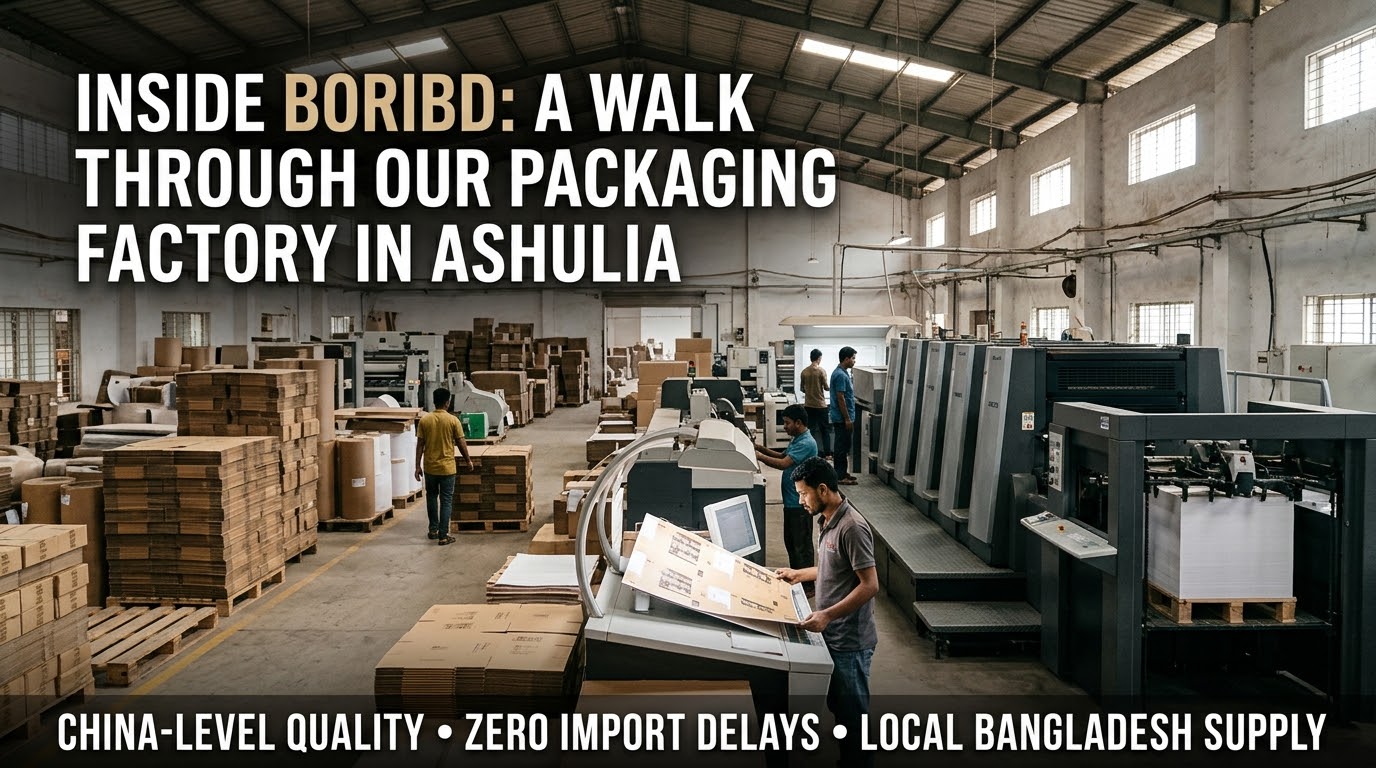
Inside BORI: A Walk Through Our Packaging Factory in Ashulia, Bangladesh
Looking for premium packaging without the cost and delays of importing from overseas? The right local packaging partner can help your business reduce logistical complexity, approve samples faster, and keep production moving.
At BORI, we bring custom packaging production closer to the businesses that need it. Located in Ashulia, Savar, Bangladesh, our factory supports businesses looking for quality packaging, practical solutions, and dependable service.
From custom boxes to hangtags and labels, we help turn packaging ideas into products that represent your brand.
In this guide, you’ll discover how a packaging order moves from the first design discussion to the finished product, why local production can benefit your business, and what to consider when choosing a packaging manufacturer in Bangladesh.
Why Are Businesses Looking for Packaging Beyond China?
Importing packaging from China can work well for some businesses. However, the quoted unit price doesn’t always tell the full story.
International orders may involve shipping costs, customs procedures, additional handling charges, and longer delivery times. If you need to change a design or correct a sample, the process can become more complicated.
These challenges can affect production schedules, inventory planning, and product launches.
Local packaging production offers another option.
Working with a packaging factory in Bangladesh can make communication easier and sample reviews more convenient. It can also reduce the need for international shipping and customs clearance for packaging produced locally.
For businesses that need regular packaging supplies, these advantages can make a meaningful difference.
The best choice depends on your order quantity, packaging specifications, quality requirements, and total delivered cost. Comparing the complete cost of each option is more useful than comparing unit prices alone.
Why Choose a Packaging Factory in Ashulia, Bangladesh?
Ashulia, in the Savar area near Dhaka, is strategically positioned for businesses operating in Bangladesh’s garment and manufacturing sectors.
For companies that need packaging close to their production facilities, location can be an important advantage.
Here’s why local access matters.
1. Easier Communication
Discussing packaging requirements is simpler when you can communicate directly with your supplier.
You can explain your product dimensions, branding requirements, preferred materials, and delivery expectations. Clear communication also helps reduce misunderstandings during design and production.
2. More Convenient Sample Reviews
A packaging sample helps you evaluate the actual product before proceeding with a larger order.
Depending on the project and sample arrangements, working with a local manufacturer can make reviews, feedback, and design adjustments more convenient.
3. Better Coordination With Local Production
When packaging and product manufacturing are located in the same country, businesses may find it easier to coordinate schedules and deliveries.
This can be particularly useful for garment exporters, footwear manufacturers, e-commerce brands, and other businesses with regular packaging requirements.
4. Fewer International Shipping Complications
Packaging produced locally does not need to travel internationally before reaching your facility.
Although production and local transportation still take time, local sourcing can remove international freight and import-clearance steps from the packaging supply process.
For many businesses, this makes local manufacturing worth considering.
Inside the BORI Packaging Factory: From Idea to Finished Product
What happens after you contact a packaging manufacturer?
A successful packaging order requires more than printing a logo on a box. The design, materials, dimensions, finishing, and final construction must work together.
At BORI, the process starts with understanding your requirements and moves through the relevant design, sampling, production, and quality-control stages.
Here’s how the process works.
Step 1: Understanding Your Packaging Requirements
Every packaging project begins with a clear brief.
We need to understand what you’re packaging, how the product will be used, and how you want customers to experience your brand.
Important details include:
- Product dimensions and weight
- Required box style and structure
- Preferred packaging materials
- Brand colours, artwork, and logo placement
- Required printing and finishing
- Order quantity and delivery expectations
These details help establish the right direction for your packaging project.
For example, a shoe box has different structural requirements from a premium gift box. Similarly, an e-commerce shipping box may need different protective features from a box designed primarily for retail display.
The goal is to develop packaging that suits both your product and your business needs.
Step 2: Design and Sampling
Good packaging starts with a design that works in the real world.
After reviewing your requirements, the design process can include artwork preparation, a dieline, and sample development.
A dieline is a flat template that shows where the packaging will be cut, folded, and assembled.
It helps determine the box’s structure, dimensions, panels, and folding points before production begins.
Sampling allows you to review important details, such as:
- Product fit and internal space
- Box dimensions and structure
- Artwork placement
- Branding and visual appearance
- Folding and assembly
- Suitability for the intended use
This stage is especially important for custom packaging because even a small dimensional error can affect how a box fits or closes.
Reviewing the sample before mass production helps identify issues early and gives you a clearer understanding of the finished product.
Step 3: Choosing the Right Materials
The material you choose affects packaging strength, appearance, cost, and suitability for your product.
Different applications require different materials and structures.
For example:
Paper boxes: Suitable for many retail products, gift items, and branded packaging applications.
Corrugated boxes: Commonly used for shipping, transportation, and applications requiring additional structural protection.
Rigid-style gift boxes: Often selected for premium presentation and products where the unboxing experience matters.
Printed labels and hangtags: Help communicate product information, brand identity, and visual details.
The right choice depends on your product, budget, design, and performance requirements.
At BORI, our aim is to help customers identify suitable packaging options for their individual projects.
Step 4: Printing Your Brand Identity
Printing brings your packaging design to life.
Colours, typography, images, and logos work together to create a consistent brand presentation.
For businesses selling clothing, footwear, accessories, gifts, and consumer products, printed packaging can help customers recognise a brand and understand its positioning.
However, attractive printing requires more than a good design file. Artwork preparation, material selection, and production control all influence the final appearance.
Before production, make sure your artwork is approved and that your supplier understands your colour and print requirements.
BORI’s goal is to help businesses turn approved packaging designs into professional branded products.
Step 5: Finishing for a More Premium Appearance
Finishing can change the way packaging looks and feels.
Depending on the product requirements and available production options, finishing techniques may include:
- Gloss lamination: Creates a shiny surface.
- Matte lamination: Provides a softer, less reflective appearance.
- Spot UV: Adds a glossy effect to selected areas of a design.
- Embossing: Raises selected design elements.
- Debossing: Presses selected design elements into the material.
- Foil stamping: Adds a metallic or decorative effect to selected areas.
Not every technique is suitable for every material or budget.
For example, a minimalist gift box may benefit from matte lamination and subtle foil details. A colourful retail box may need a different combination of printing and finishing.
The key is to choose finishes that support your brand rather than adding unnecessary cost.
Note: Confirm the specific finishing options available for your order with BORI before finalising your specifications.
Step 6: Die-Cutting, Folding, and Assembly
Once the relevant printing and finishing stages are complete, packaging components move through the appropriate cutting and construction processes.
Die-cutting creates the required shape and structural details. Folding and gluing help turn flat printed sheets into usable boxes.
Accuracy matters at every stage.
Incorrect dimensions can cause fitting problems. Poor folding can affect the box’s appearance. Inconsistent construction can make packaging difficult to assemble or close.
For branded packaging, consistency across the order is just as important as the appearance of the first sample.
A well-planned production process helps ensure that packaging is suitable for its intended use.
Step 7: Quality Inspection
Packaging quality affects more than appearance.
Boxes must have suitable dimensions, appropriate construction, and printing that meets the approved requirements.
Before placing an order, ask your supplier how quality is checked and what happens if a problem is identified.
Depending on the packaging specification, inspection may cover:
- Dimensions and structural accuracy
- Printing and artwork placement
- Material condition
- Finishing quality
- Folding and assembly
- General appearance and consistency
At BORI, quality is an important part of the packaging process.
Our focus is to help customers receive packaging that meets the agreed requirements and represents their brand professionally.
Step 8: Delivery and Order Coordination
The final stage is getting the finished packaging to your facility.
With local production, businesses can avoid the international freight and customs-clearance stages associated with importing packaging from overseas.
However, the actual delivery schedule depends on production capacity, order quantity, material availability, finishing requirements, and transportation arrangements.
When requesting a quotation, share your required delivery date and ask for an estimated production timeline.
Clear expectations from the beginning help both sides plan more effectively.
China vs. Local Packaging in Bangladesh: Which Is Better?
There is no single answer for every business.
Importing from China may suit some high-volume orders or specialised packaging requirements. Local manufacturing may be more practical when communication, sample reviews, delivery coordination, and reduced international shipping are priorities.
Consider the following comparison.
| Factor | Importing Packaging From China | Sourcing Packaging Locally in Bangladesh |
|---|---|---|
| Transportation | International shipping is usually required | Local transportation is required |
| Import procedures | Customs clearance and related procedures may apply | No international import clearance for locally produced goods |
| Sample review | May involve international courier services | Local sample review may be more convenient |
| Design changes | Can require additional coordination and shipping | Communication and revisions may be easier to coordinate |
| Total cost | Includes production and applicable import-related costs | Includes production and local delivery costs |
| Lead time | Depends on production, shipping, and clearance | Depends on production capacity and local delivery |
| Communication | May involve time-zone or language differences | Local communication may be more convenient |
Which option should you choose?
Compare quotations using the same specifications, materials, quantities, finishing requirements, and delivery terms.
For imported packaging, include applicable freight, duties, taxes, clearance charges, and other relevant costs. For local packaging, include production, transport, and any additional charges.
This approach gives you a more realistic comparison.
Who Can Benefit From BORI’s Packaging Solutions?
Different businesses use packaging for different reasons. The right solution depends on the product, sales channel, and customer expectations.
BORI works with packaging requirements across several product categories.
Garment and Textile Businesses
Garment manufacturers and exporters may require packaging that supports product presentation, identification, handling, and shipment.
Custom boxes, hangtags, and printed labels can help maintain a consistent brand identity.
Footwear Manufacturers
Shoe boxes need to accommodate the product while supporting storage, handling, and presentation.
Custom printing and branding can also help footwear companies create a more consistent retail experience.
E-commerce and Direct-to-Consumer Brands
For online businesses, packaging is often part of the customer’s first physical interaction with a brand.
Branded boxes can make deliveries more recognisable and create a more considered unboxing experience.
Gift and Premium Product Brands
Gift boxes and other premium packaging can help communicate attention to detail.
Material selection, structure, printing, and finishing all contribute to the final presentation.
Toy and Consumer Product Businesses
Custom packaging can help present a product clearly while providing suitable protection and space for branding and product information.
The packaging design should reflect the product’s dimensions, intended market, and applicable requirements.
What Packaging Products Can You Order From BORI?
BORI’s packaging product range includes:
- Custom shoe boxes
- Gift boxes
- Paper boxes
- Corrugated boxes
- Toy boxes
- Hangtags
- Printed labels
The most suitable product depends on your packaging requirements.
For example, a footwear manufacturer may need branded shoe boxes, while an apparel business may prioritise hangtags and printed labels.
If you need several packaging components for the same brand, discuss your complete requirements when requesting a quotation.
This helps your supplier understand the project as a whole rather than treating every item as an unrelated order.
How to Choose the Right Packaging Manufacturer in Bangladesh
Choosing a packaging supplier is an important business decision. The lowest quotation does not always provide the best overall value.
Before placing an order, consider these five points.
1. Check product experience.
Ask whether the supplier has experience with your required packaging type, material, and construction.
2. Review a physical sample.
A sample allows you to assess dimensions, printing, finishing, and overall construction before approving production.
3. Confirm material specifications.
Make sure the quoted material matches your expectations for appearance, strength, and intended use.
4. Ask about quality control.
Understand what is inspected, how defects are handled, and how the supplier maintains consistency across an order.
5. Compare the complete quotation.
Review production costs, sampling charges, finishing, delivery, payment terms, minimum order quantities, and lead times.
These steps can help you make a more informed decision and avoid preventable problems later.
Frequently Asked Questions About Packaging Factories in Bangladesh
1. Where is BORI’s packaging factory located?
BORI’s packaging factory is located in Ashulia, Savar, Bangladesh, near Dhaka.
2. Is locally manufactured packaging in Bangladesh comparable to packaging from China?
It can be. Quality depends on materials, equipment, production processes, finishing, and quality control—not simply the country where the packaging is made.
Ask suppliers for physical samples and compare them against your specifications before placing an order.
3. Is local packaging cheaper than importing from China?
Local packaging can offer cost advantages by reducing international freight and import-related expenses.
However, the final cost depends on order quantity, materials, design complexity, finishing, production efficiency, and delivery requirements. Compare complete quotations to determine which option offers better value.
4. What types of custom packaging does BORI offer?
BORI’s product range includes shoe boxes, gift boxes, paper boxes, corrugated boxes, toy boxes, hangtags, and printed labels.
Contact BORI to discuss your required packaging specifications and confirm availability for your project.
5. Can I request a packaging sample before placing a bulk order?
Sample development is an important way to review packaging dimensions, structure, artwork, and appearance before production.
Contact BORI to discuss your sample requirements, the approval process, and any applicable charges.
6. What information should I provide to get a packaging quotation?
For a more accurate quotation, prepare the following information:
- Packaging type and intended use
- Length, width, and height
- Material preferences, if known
- Printing and finishing requirements
- Artwork or design files, if available
- Required quantity
- Delivery location and target date
Providing these details helps the supplier understand your needs and prepare a more relevant quotation.
7. Can I visit the BORI factory?
Contact BORI to confirm factory-visit arrangements and schedule a suitable time.
8. How long does custom packaging production take?
Production time varies according to packaging complexity, materials, order quantity, sampling, finishing, and production schedules.
Share your deadline when requesting a quotation so the expected timeline can be discussed before you place your order.
Ready to Find the Right Packaging Solution for Your Business?
Your packaging should do more than contain a product. It should support your brand, meet practical requirements, and arrive when you need it.
BORI helps businesses explore custom packaging solutions from its facility in Ashulia, Savar, Bangladesh.
Whether you need shoe boxes, gift boxes, paper boxes, corrugated boxes, toy boxes, hangtags, or printed labels, the first step is to explain what you need.
Tell us about your product, quantity, design, and delivery requirements. Our team can discuss suitable packaging options and help you take the next step toward your order.
Visit www.boribd.com to learn more about BORI and request a quotation.
BORI — Your packaging starts with us, and stays with us.