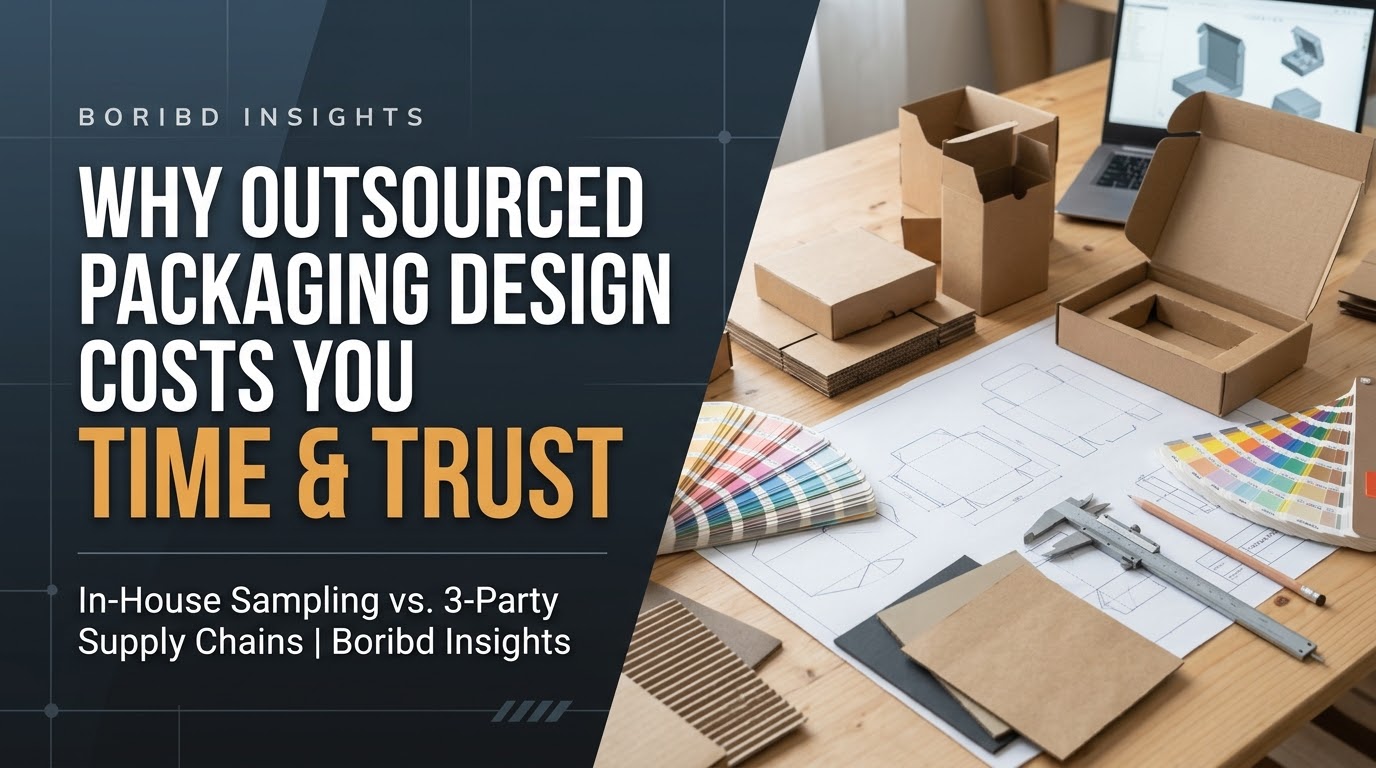
Why BORI Keeps Packaging Design and Sampling In-House (Not Outsourced)
Your packaging can look perfect on a computer screen and still disappoint when the finished box arrives. The size may be wrong, the material may feel too thin, or the lid may not close properly.
For businesses investing in custom packaging, these small mistakes can lead to wasted materials, production delays, and unnecessary costs.
At BORI, we take a different approach. We keep packaging design and sampling inside our own factory in Ashulia, Savar, Bangladesh. Our design and production teams work closely together to develop packaging that looks right, fits the product, and can be manufactured to the required specifications.
The result? Better communication, more practical designs, and a smoother journey from the first idea to the finished packaging.
What Is In-House Packaging Design and Sampling?
In-house packaging design and sampling means developing packaging designs and producing physical samples within the manufacturer’s own facility instead of sending the work to outside designers or sample-making workshops.
At BORI, our team develops the box structure, prepares the dieline, and creates samples while working closely with the people responsible for production.
This connection between design and manufacturing helps us identify potential problems early, make necessary adjustments, and prepare packaging for production more efficiently.
Whether you need custom shoe boxes, gift boxes, paper boxes, corrugated boxes, toy boxes, hangtags, or printed labels, the goal remains the same: develop a practical solution that meets your product and branding requirements.
Why Outsourced Packaging Design Can Create Problems
Imagine you are preparing to launch a new skincare product.
You hire a designer to create the artwork, send the design to another workshop for sampling, and then place your order with a packaging manufacturer.
Everything seems straightforward until the sample arrives.
The box is slightly too small. The insert does not hold the product securely. The printed colours look different from what you expected. You request changes, and the process starts again.
The problem is not necessarily that any one team did poor work. It is that several teams are working separately, and important production details can get lost between them.
Common challenges include:
- Incorrect dimensions: The box does not fit the product as intended.
- Material differences: The sample uses a board or paper that differs from the final production specification.
- Finishing problems: Lamination, embossing, debossing, or other finishing details may not match expectations.
- Slow revisions: Every change requires communication between different people or companies.
- Production delays: Problems discovered late can affect the delivery schedule.
This is why packaging design should consider more than appearance. It must also account for materials, structure, finishing, assembly, and manufacturing requirements.
5 Benefits of BORI’s In-House Packaging Design and Sampling
1. Packaging Samples Designed for Real Production
A packaging sample is more than a visual preview. It helps you evaluate the dimensions, structure, material, and overall appearance before committing to a larger order.
At BORI, our design and sampling teams work alongside production operations. This allows them to consider how the packaging will be printed, finished, die-cut, folded, and assembled.
For example, a custom gift box may look attractive in a digital design but require adjustments to its lid, insert, or folding structure before it is ready for manufacturing.
By identifying these details during development, we can help reduce the risk of avoidable production problems.
The value for your business: You can make more informed decisions before approving your packaging for bulk production.
2. Faster Feedback and Design Revisions
Packaging projects often change during development.
You might need to adjust the box dimensions, change the insert, select another material, or update your brand artwork.
When the design and sampling teams work within the same factory, communication can be more direct. Our team can review the requested changes with production staff and determine what adjustments are practical.
This approach helps reduce unnecessary communication between separate suppliers.
The value for your business: A more straightforward revision process and fewer avoidable delays during packaging development.
Actual turnaround times depend on the design’s complexity, material availability, and the number of revisions required.
3. Better Quality Control Before Bulk Production
A packaging problem is generally easier to address during sampling than after a large production run has started.
For this reason, design and sampling should include checks that go beyond visual appearance.
At BORI, our development process considers important details such as:
- Box dimensions and structural design.
- Material selection and thickness.
- Folding, gluing, and assembly requirements.
- Artwork placement and printing specifications.
- Die-cutting accuracy.
- Finishing requirements and production feasibility.
These checks help the team identify issues that could affect the finished packaging.
For example, if a shoe box lid does not fit correctly during sampling, the structure can be reviewed before the full order moves into production.
The value for your business: Potential problems can be identified earlier, helping reduce the risk of material waste, rework, and costly corrections.
4. Greater Control Over Your Packaging Information
Packaging development may involve confidential artwork, product dimensions, brand guidelines, and details about upcoming product launches.
Working with multiple external providers can mean sharing these materials with several separate parties.
BORI’s in-house approach keeps design and sampling activities within our own facility, reducing the need to send this work to outside design studios or sampling workshops.
This gives your project a more controlled workflow.
The value for your business: Fewer external handoffs during development and greater control over how your packaging project is handled.
As with any manufacturing arrangement, confidentiality also depends on appropriate internal procedures and information-handling practices.
5. Clearer Responsibility From Design to Production
When different companies handle design, sampling, and manufacturing, it can become difficult to determine where a problem started.
A designer may blame the sample maker, while the manufacturer may point to the original design.
An integrated workflow makes collaboration more straightforward.
At BORI, our design and production teams work together to evaluate packaging requirements and address practical manufacturing concerns during development.
This helps connect the original concept with the finished product.
The value for your business: Clearer communication, more coordinated decisions, and a more consistent packaging development process.
In-House vs. Outsourced Packaging Design: What’s the Difference?
Both approaches can work, but the right choice depends on your product, project requirements, and supplier.
Here is how they typically compare.
| Comparison | BORI’s In-House Approach | Fully Outsourced Approach |
|---|---|---|
| Design and sampling | Handled within the factory | May involve separate providers |
| Communication | Direct coordination between teams | May require communication through several parties |
| Design revisions | Can be discussed with production staff | May require additional coordination |
| Production feasibility | Considered during development | Depends on communication between providers |
| Quality checks | Can be coordinated within the factory | Responsibilities may be divided |
| Project accountability | More closely connected across the workflow | May be split between suppliers |
The key difference is coordination. When design, sampling, and manufacturing teams work together, they can address practical production requirements earlier in the process.
However, an outsourced supplier can also deliver excellent results when communication, specifications, and quality-control procedures are well managed.
The important question is not simply where the design is created. It is how effectively the entire process is managed.
How BORI’s Packaging Design and Sampling Process Works
Our process connects your initial requirements with a sample that can be reviewed before production.
Step 1: Share Your Packaging Requirements
Tell us about your product, packaging type, required quantity, preferred materials, and budget.
If you already have artwork or a reference sample, you can share those details to help us understand your expectations.
Step 2: Develop the Box Structure and Dieline
Our design team develops the packaging structure and prepares the dieline.
A dieline is a flat template that shows where the packaging will be cut, folded, and assembled.
It helps define the box’s dimensions and construction before sampling begins.
Step 3: Create a Physical Sample
The team develops a sample based on the agreed design and material specifications.
Depending on the project, the sample may be used to evaluate the box structure, dimensions, appearance, and finishing requirements.
A physical sample helps you assess details that are difficult to judge from a screen alone.
Step 4: Review and Refine the Design
You review the sample and share your feedback.
If adjustments are needed, the team can evaluate changes to the dimensions, structure, artwork, materials, or finishing.
The aim is to resolve important questions before approving the packaging for bulk production.
Step 5: Approve the Sample and Begin Production
Once the sample and specifications are approved, they become the reference for the production order.
The manufacturing team can then follow the agreed requirements for printing, finishing, die-cutting, assembly, and inspection.
Any subsequent changes should be confirmed before production so that everyone is working from the correct specifications.
Which Businesses Benefit Most From In-House Packaging Sampling?
In-house design and sampling can be particularly valuable for businesses that need custom packaging, accurate product fit, distinctive branding, or repeated production orders.
Fashion and Garment Brands
Custom garment boxes, hangtags, and printed labels help communicate brand identity and product information.
Sampling allows businesses to review dimensions, artwork placement, materials, and finishing before ordering in bulk.
Footwear Manufacturers and Shoe Brands
Shoe boxes must accommodate the product while meeting storage, handling, and presentation requirements.
A sample helps confirm the box dimensions, lid fit, construction, and printing specifications.
Cosmetics and Skincare Businesses
Cosmetic packaging often requires careful attention to presentation, structure, and product fit.
A physical sample allows brands to assess the packaging before committing to a larger order.
Product safety, material suitability, and regulatory requirements must also be considered where applicable.
Gift and Premium Product Brands
Gift boxes often rely on their structure, material, and finishing to create the intended presentation.
Sampling helps businesses review details such as inserts, lids, surface finishes, and assembly.
E-Commerce and Growing Businesses
For online sellers and new brands, packaging must balance appearance, product protection, and cost.
Testing a sample before production helps identify practical adjustments and provides an opportunity to review the design before placing a larger order.
Why Choose BORI for Custom Packaging Design and Sampling in Bangladesh?
BORI is a packaging manufacturer based in Ashulia, Savar, Bangladesh, serving businesses that need custom packaging solutions.
Our approach connects packaging development with manufacturing instead of treating design as a separate activity.
We focus on:
- In-house design and sampling: Development takes place within our own facility.
- Practical box structures: Designs consider how packaging will be manufactured and assembled.
- Production-focused collaboration: Designers work with production teams to review technical requirements.
- Custom packaging options: Solutions can be developed for shoe boxes, gift boxes, paper boxes, corrugated boxes, toy boxes, hangtags, and labels.
- Finishing choices: Depending on the product and specifications, options may include gloss or matte lamination, spot UV, embossing, and debossing.
Our goal is to help customers move from an initial packaging idea to a practical design that is ready for production.
If you are comparing packaging manufacturers in Bangladesh, ask whether the supplier can develop physical samples, explain its quality-control process, and clarify how approved specifications will be followed during manufacturing.
These questions can help you make a more informed decision.
Frequently Asked Questions About Packaging Design and Sampling
What is in-house packaging design?
In-house packaging design is the process of developing packaging artwork and structure within a manufacturer’s own facility. It allows the design team to coordinate directly with production staff when evaluating materials, dimensions, and manufacturing requirements.
Why is in-house packaging sampling important?
In-house sampling helps connect the design with the actual manufacturing process. It can make communication and revisions easier while helping identify structural, dimensional, material, and finishing issues before bulk production.
Does BORI provide custom packaging samples?
BORI develops packaging designs and samples within its own facility. Sample availability, materials, finishing options, lead times, and costs should be confirmed according to your specific project requirements.
Can I provide my own packaging artwork?
Yes. You can share your existing artwork and packaging requirements for review. The design team can assess how the artwork fits the box structure and identify any adjustments needed before production.
Can BORI help if I do not have a packaging design?
You can share your product details, preferred packaging type, dimensions, and branding requirements. BORI’s team can review the information and discuss suitable design and sampling options for your project.
Does in-house packaging design reduce costs?
It can help reduce avoidable costs by identifying problems before bulk production. For example, correcting an unsuitable box structure during sampling may prevent larger quantities of packaging from requiring rework.
However, the actual savings depend on the project, materials, complexity, and production quantity.
How long does packaging sampling take?
The timeline depends on the packaging design, material availability, finishing requirements, and the number of revisions. Contact BORI with your project details to discuss the expected sampling schedule.
Where is BORI located?
BORI’s packaging facility is located in Ashulia, Savar, Bangladesh. The company serves businesses seeking custom packaging solutions in Bangladesh and export-oriented markets.
For the exact factory address and confirmed service areas, contact the BORI team or visit the company’s official website.
Start Your Custom Packaging Project With BORI
Your packaging should work in production just as well as it looks in a design file.
By keeping design and sampling in-house, BORI brings the people developing your packaging closer to the people manufacturing it. This helps connect your requirements with practical decisions about structure, materials, finishing, and production.
Whether you need custom shoe boxes, gift boxes, paper boxes, corrugated boxes, toy boxes, hangtags, or printed labels, starting with a well-developed sample can help you make better decisions before placing a bulk order.
Have a packaging idea in mind?
Visit Boribd.com to explore our packaging solutions and contact our team about your design, sampling, and manufacturing requirements.
Let’s work together to develop packaging that fits your product, reflects your brand, and is ready for production.